
 Dale Shelabarger
Restaurant operators have relatively limited control over external pressures, be they food inflation, energy prices or supply chain problems. What they do have control over is precisely what they purchase, in what quantities and when.
Yet these decisions are rarely straightforward. Managers must balance anticipated demand against existing stock. Ingredient requirements also need to be calculated and supplier delivery schedules accounted for.
The process can be time-consuming and prone to error, with inaccurate orders leading to excess stock, waste or shortages. For restaurant chains, different purchasing habits and procedures across locations can create further complications.
Accurate forecasting is therefore crucial, as is the reliability of the underlying sales data. Equally important is how those forecasts are translated into ingredient requirements, reconciled with existing stock levels and adjusted for supplier lead times and delivery schedules.
Where Existing Purchasing Technology Falls Short
As it stands, restaurant operators have at their disposal an extensive array of options when it comes to purchasing management. Technology has made considerable advances in this area, covering inventory control, forecasting and purchasing automation. But the extent to which these capabilities work together varies quite considerably between platforms.
Many of the larger systems rely on additional integrations to connect forecasting with inventory and purchasing. Some can generate suggested supplier orders but still requires managers to review the order and then submit them manually.
As a result, forecasting, stock management and purchasing are not always integrated into a single, automated process.
Introducing Syrve’s AI Purchasing Agent
Syrve’s AI Purchasing Agent brings all of these elements together in a connected native workflow, linking sales forecasting, recipe requirements, inventory data and supplier ordering.
Rather than requiring managers to calculate purchasing quantities manually, the system uses predicted demand and available stock to determine what needs to be ordered, in what quantities and when.
Purchase orders can then be generated automatically and processed according to the restaurant’s configured approval and sending procedures.
Here’s a breakdown of how the process works:
How Syrve’s AI Purchase Agent Works
1. Data Capture
Syrve captures a raft of operational data across individual restaurant locations. This includes POS sales, daily revenue, transaction volumes and average check values. Ingredient consumption, stock movements and write-offs are also recorded, providing a detailed picture of trading activity and inventory.
Rather than gathering information from separate systems or relying on manually maintained records, operators can access this data through a connected restaurant management platform.
2. Forecast Demand
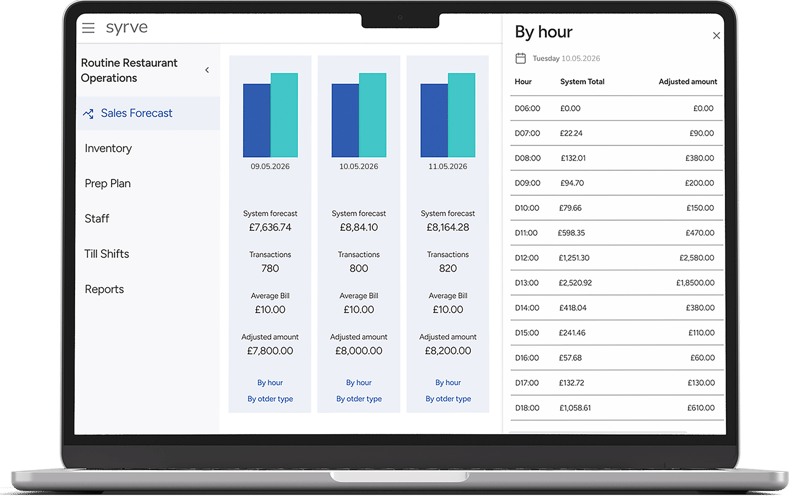
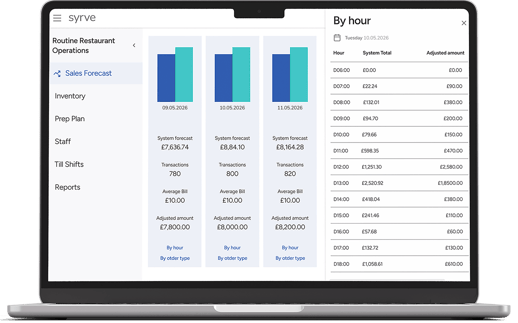
Syrve's AI Sales Forecast analyses historical sales data to identify trading patterns and predict upcoming demand at individual restaurant locations. The system generates a rolling three-week sales forecast, which is updated weekly, with predictions extending down to individual menu items and hourly trading periods.
Operators can review and adjust these forecasts to factor in circumstances that historical data might not adequately reflect. A forthcoming local event, a large group booking, adverse weather conditions or nearby roadworks, for example, could all influence customer demand.
By combining historical sales data with local knowledge, Syrve provides a more informed and consistent starting point for calculating ingredient requirements, rather than relying solely on previous sales figures or individual managerial judgement.
3. Calculate Ingredient Requirements
Syrve translates forecast menu sales into the quantities of individual ingredients required to meet anticipated demand. Using the system's recipe data, these calculations account for portion sizes, semi-finished products and preparation losses.
Where ingredients are used across multiple menu items, Syrve calculates their combined requirements based on expected sales. Recipe specifications can also accommodate differences between restaurant locations, ensuring that calculations reflect each site's particular needs.
The result is a detailed breakdown of anticipated ingredient consumption for each restaurant. This effectively provides the basis for determining purchasing quantities once existing stock levels and supplier schedules have been taken into account.
4. Check Available Stock
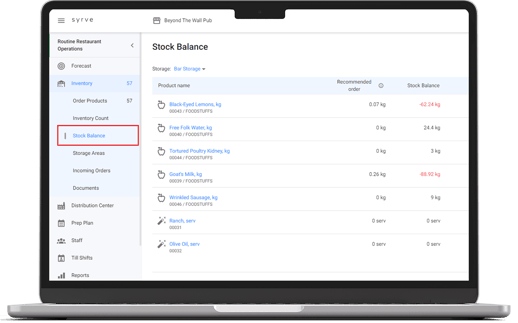
After forecast ingredient requirements have been calculated, Syrve enables operators to compare them against existing inventory at each restaurant location. This is what helps establish the difference between what kitchens are expected to consume and what actually needs to be purchased.
Stock positions can vary considerably between locations. Two restaurants with similar sales forecasts, for example, might require very different quantities of the same ingredient. Syrve provides visibility into existing inventory alongside forecast consumption, so that operators can assess their requirements against the stock already available.
In addition, the system identifies negative stock balances and allows out-of-stock products to be filtered for review. This is especially important given the fact that inaccurate inventory records can distort purchasing calculations, potentially leading to unnecessary orders or unexpected shortages.
5. Calculate Purchasing Quantities
Syrve then calculates the quantities that each restaurant needs to order. This is a critical step which ensures that purchasing recommendations reflect what is already available rather than anticipated consumption alone.
Supplier arrangements are factored into these calculations as well. Operators can configure delivery schedules, lead times and ordering deadlines. Syrve factors this into its calculations and determines the quantities required to cover expected consumption until the next delivery.
In practice, this means that restaurants with similar sales forecasts may receive very different purchasing recommendations, depending on their stock positions and supplier arrangements. Ultimately, the result is a more accurate, location-specific approach to purchasing that reduces the need for manual calculations.
6. Generate and Send Purchase Orders
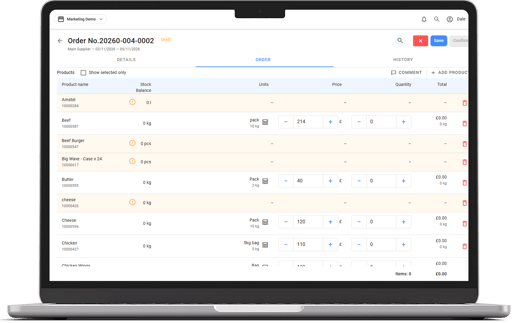
Following the calculation of purchasing quantities, Syrve’s AI purchasing agent automatically generates purchase orders according to configured supplier schedules. In doing so, it also takes into account delivery lead times and order submission deadlines.
Purchase orders can then be sent directly to suppliers by email or through supported integrations, including FTP. This removes much of the repetitive administration involved in preparing and coordinating orders across multiple restaurant locations.
By connecting purchasing calculations with order generation and submission, Syrve creates a continuous workflow from demand forecasting through to procurement. This can dramatically reduce manual intervention, not to mention the potential for errors.
Automated Purchasing Without Sacrificing Control
Importantly, automation doesn't have to mean relinquishing control over purchasing decisions. Syrve supports configurable approval procedures which means that purchase orders can be reviewed before they're submitted to suppliers.
For restaurant managers and central procurement teams, the emphasis can therefore shift from preparing routine orders to reviewing those that require closer attention. Unusual purchasing quantities, discrepancies in stock records or unexpected changes in demand can all warrant further investigation.
Human judgement remains an important part of the process. But it can be directed towards decisions that genuinely require intervention rather than repetitive calculations and administrative tasks.
In effect, Syrve’s purchasing tools translate to less calculating, less guesswork and much tighter stock control.
Closing the Gap Between Forecasting and Purchasing
Accurate sales forecasting is an important part of restaurant purchasing, but it's only the starting point. Those predictions still need to be translated into ingredient requirements, reconciled with existing stock and converted into supplier orders.
By connecting these processes within a single automated workflow, Syrve helps restaurants and restaurant groups reduce their dependence on manual calculations and disconnected purchasing procedures.
For single-site restaurants, this means a more reliable approach to determining what needs to be purchased and when. For multi-site operators, it also provides greater consistency across locations, without sacrificing the flexibility needed to accommodate individual restaurant requirements.


